Solutions overview
 Account take over (ATO)
 Digital Impersonation
 Credit card data theft
 Man in the Middle (MitM)
 Credential stuffing
 SEO poisoning
 For security teams
 For fraud/risk teams
 For digital business teams
 Library
 Blog
Blog Glossary
 Partner Up
 About
About News
News Events
 Careers
 Contacts
Modern account takeover (ATO) fraud tod is a critical threat to digital businesses. Despite heavy investment in MFA and login anomaly detection, many attacks succeed because they bypass traditional safeguards entirely.
Modern ATO doesn’t start at the login screen. It begins upstream with pre-login exposure and real-time credential relay, allowing attackers to hijack sessions before traditional defenses even engage.
This guide breaks down how modern ATO attacks actually unfold, why traditional detection falls short, and how security teams are moving prevention earlier to stop attacks before credentials are misused.
If this sounds familiar, it’s because many organizations don’t realize an ATO has already succeeded until customers start reporting it.
Table of Contents
What Is Account Takeover (ATO) Fraud?
Account takeover (ATO) fraud is a form of identity theft in which attackers gain unauthorized access to a user’s online account, such as banking, eCommerce, loyalty, email, or SaaS, and use it to steal funds, data, or rewards.
Attackers typically rely on stolen credentials obtained through phishing, data breaches, malware, or social engineering. Increasingly, they bypass MFA using real-time credential relay or man-in-the-middle techniques.
Once inside the account, fraudsters can change recovery details, lock out the legitimate user, and monetize access, causing financial, operational, and reputational damage.
How Do Modern Account Takeovers Happen?
To understand why traditional controls struggle, it helps to look at how modern ATO attacks actually unfold.
Account takeover doesn’t begin at login. It starts earlier, often with a phishing email, fake website, or spoofed brand message designed to trick users into handing over credentials.
Phishing and Brand Impersonation
Attackers begin by impersonating a trusted brand, service, or internal function. Victims are lured through phishing emails, SMS messages, ads, or search results that lead to convincing lookalike domains or cloned login pages.
These impersonation assets are engineered to appear legitimate and to create urgency, such as account warnings, security alerts, or transactional prompts. At this stage, no authentication has occurred and no security control has yet been triggered.
This exposure phase is where modern ATO campaigns are launched and scaled.
Credential Harvesting and Real-Time Relay
When users interact with the fake site, credentials are captured. In traditional phishing attacks, these credentials may be stored and exploited later. In modern attacks, harvesting and exploitation often occur simultaneously.
Advanced phishing infrastructure now operates as a real-time proxy between the user and the legitimate site. Using reverse-proxy or Adversary-in-the-Middle (AiTM) techniques, credentials and MFA responses are relayed instantly as the user enters them.
From the user’s perspective, authentication appears to succeed normally and nothing unusual has happened yet. In reality, control is already shifting to the attacker. This compression of credential capture and relay removes the delay many traditional defenses depend on.
Session Establishment and Control Transfer
Once authentication completes, the attacker gains control of a valid, authenticated session. Session tokens, cookies, or authentication state are now active and trusted by the legitimate application.
Because authentication succeeds using valid credentials and expected flows, MFA and anomaly-based detection often fail to trigger. From the system’s perspective, the session is indistinguishable from legitimate access.
At this point, the account is effectively compromised, even though no security alert may have fired.
Account Takeover and Exploitation
With session control established, attackers can act quickly to monetize access. Common actions include transferring funds or loyalty points, changing passwords or recovery details, accessing sensitive data, or making unauthorized purchases.
These actions often occur before alerts are raised or before the legitimate user realizes anything is wrong. Because access is established through valid credentials and an authenticated session, downstream activity appears legitimate to many controls.
At this stage, prevention is no longer possible. Detection becomes reactive, and organizations are left responding to consequences rather than interrupting the attack. By the time exploitation is visible, the window for effective intervention has already closed.
Why Phishing-Based Account Takeover Is Harder to Detect
After a notable dip in 2024, phishing campaigns have scaled again dramatically. The Anti-Phishing Working Group (APWG) recorded 1,003,924 incidents in Q1 2025 rising 13% to 1,130,393 in Q2 of the same year – the highest quarterly total since 2023.
This surge isn’t driven by more sophisticated attackers. It’s driven by easier access to off-the-shelf phishing kits, phishing-as-a-service platforms, and one-click website cloning tools that allow convincing fake sites to be deployed in minutes.
These tools compress the time between impersonation launch and exploitation. As a result, the window of exposure widens and attacks are more likely to succeed before defenses engage.
The most dangerous variants rely on real-time proxy techniques that sit between the user and the legitimate site, silently relaying credentials and authentication responses while everything appears normal.
In these attacks, MFA isn’t bypassed. Rather, it’s successfully completed by the victim and relayed to the attacker in real time.
As a result, these attacks:
-
Preserve the appearance of legitimate login behavior
-
Defeat MFA’s protective intent without breaking MFA itself
-
Evade anomaly-based detection that assumes post-login compromise
From the system’s perspective, authentication succeeds. In reality, control is lost during the authentication process.
This is why phishing-based account takeover cannot be addressed solely at the login screen. Effective prevention requires visibility into phishing exposure, credential relay activity, and suspicious device behavior before authentication occurs.
The Window of Exposure: Where Account Takeover Actually Begins
The window of exposure (WoE) spans from the moment an impersonation asset goes live through the period in which stolen credentials can be used to establish attacker-controlled access, before traditional controls meaningfully engage. This explains why takedown-based defenses leave a critical gap attackers routinely exploit. By the time most teams are alerted, the decisive moment has already passed.
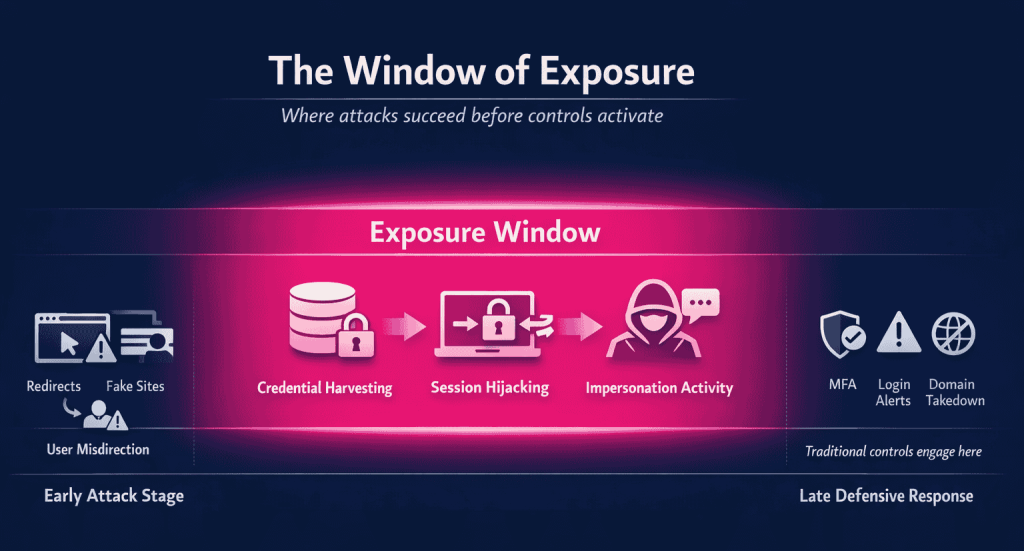
During this phase, no authentication failure has occurred. Users behave normally, credentials are entered willingly, and sessions appear legitimate. From a security system’s perspective, there’s nothing yet to block.
This is why many controls fail by design. Takedowns are reactive, MFA activates too late, and login-based detection only engages after credentials have already been exposed. By the time suspicious activity is visible, the attacker is often already inside the account or in the process of taking control.
Reducing the window of exposure changes the outcome. Independent analyst research identifies timing, not control coverage, as the core failure in fraud prevention. Most defenses engage only during and after authentication, missing the impersonation and credential relay phase where most attacks now succeed.
When impersonation activity and user exposure are recognized early, credentials can be protected as they’re entered, attacker devices can be tracked across phases, and intervention can occur before account recovery controls are modified or access is monetized.
Common ATO Vectors Mapped by Attack Phase
| Vector | Primary attack phase | What breaks trust | Why traditional controls miss It | Where early signals exist |
| Phishing and brand impersonation | Pre-login exposure | User trusts a fake interface | No authentication event has occurred | Fake site interaction, lookalike domains, referral context |
| Reverse proxy (AiTM) phishing | Credential capture and authentication | Credentials and MFA are relayed live | Login appears legitimate | Credential relay indicators, abnormal device and session continuity |
| Credential stuffing | Authentication | Password reuse at scale | Distributed or low-volume testing using reused credentials | Device reuse patterns, failure accumulation |
| Malware and infostealers | Pre-login compromise | Credentials stolen outside the session | Occurs off-channel | Reuse of compromised credentials, prior device risk context |
| Brute force (including low-rate) | Authentication | Guessing over time | Activity stays below alert thresholds | Per-device failure correlation |
| SIM swapping | Trust reset and recovery | Out-of-band identity takeover | Treated as a legitimate reset | Device continuity breaks following recovery or reset events |
| Remote access–enabled scams | Active session | Shared or coerced session control | User authorizes actions | Remote session indicators, high-risk device and access context |
How Remote Access Fraud Introduces a Different Detection Challenge
In these attacks, where remote desktop takeover is the primary mechanism, users are coerced into installing legitimate remote access tools, allowing attackers to join live sessions that appear user-authorized.
Because authentication succeeds and sessions look legitimate, many security controls fail to recognize that control has effectively been ceded to an attacker intent on committing remote access fraud.
For a deeper breakdown, read: How to Stop Remote Access Scams and Why Security Teams Miss the Risk
Why Traditional Account Takeover Detection Falls Short
Legacy ATO defenses are keyed to login events, which means upstream exposure and credential relay go unseen. They look for failed logins, unusual locations, or behavioral deviations. Modern attackers avoid these signals by using valid credentials, familiar devices, and expected behavior.
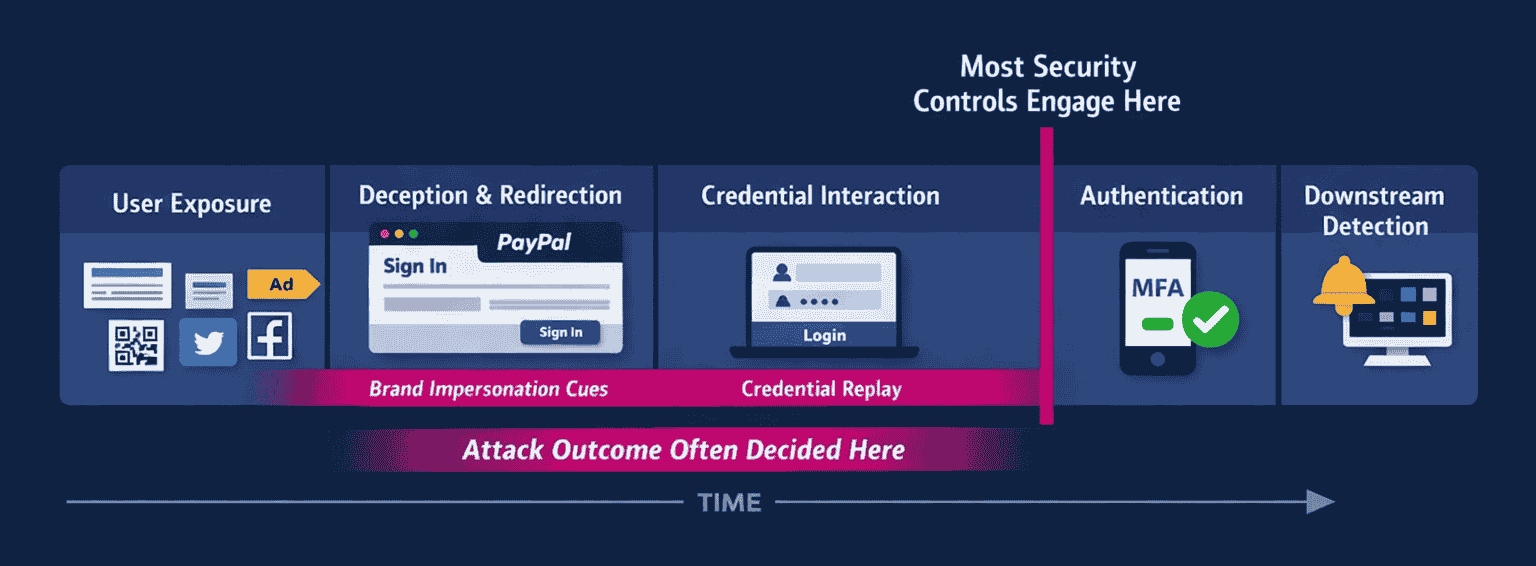
What these tools miss is upstream activity, including phishing site visits, credential harvesting, and attacker preparation. Without visibility into these early stages, detection arrives after accounts are already compromised, highlighting the difference between server-side alerts and browser-level visibility into attack activity.
The 5-Step Framework: How to Prevent Account Takeovers Preemptively
Most account takeover tools only engage once a login attempt occurs. By that point, the scam has already progressed. Modern ATO prevention depends on understanding exposure, timing, and attacker behavior before credentials are exploited.
To stop ATOs before they succeed, security teams need visibility earlier in the attack lifecycle, from impersonation exposure through device-level signals.
By identifying phishing exposure and tracking suspicious devices, security teams gain early warning of account takeover risk and a clearer view of how modern ATO prevention disrupts attacks before impact. Correlating attack patterns across incidents allows intervention before impact.
Step 1: Detect Impersonation Exposure Early
Many of today’s most damaging ATO attacks begin with phishing or digital impersonation, not with a login attempt. Attackers lure users to lookalike domains, cloned login pages, or spoofed brand assets designed to harvest credentials.
Traditional takedown services typically focus on removing these assets after they’re active, which limits their ability to prevent harm. Early ATO prevention depends on identifying lookalike domains and impersonation activity and understanding which users are being exposed, before credentials are replayed against the real site.
Step 2: Surface Scam Influence Before Login
Modern attackers often rely on valid credentials and clean devices. They often log in from the same region as the victim, deliberately avoiding the anomalies traditional ATO tools depend on.
Effective prevention starts before authentication. Solutions that surface phishing exposure, suspicious device history, or breaks in user-device continuity can identify an ATO in progress, even when the login itself appears legitimate.
This shifts detection from reactive login analysis to upstream risk recognition.
Step 3: Correlate Devices Across Attacks
ATO prevention requires pattern recognition, not isolated alerts.
When a device appears across phishing exposure, credential testing, or multiple access attempts, it becomes a strong indicator of attacker activity. Correlating devices with known impersonation infrastructure and campaign behavior enables enterprises to identify repeat attackers and reduce reliance on single-event detection.
This intelligence strengthens protection across accounts, not just individual users.
Step 4: Intervene During the Attack Window
Once stolen credentials are replayed, timing becomes the decisive factor.
Early visibility allows organizations to act while the attack is unfolding, rather than after fraud has occurred. Targeted actions, such as elevating authentication requirements, restricting sensitive workflows, or flagging high-risk access attempts, can prevent escalation without broadly disrupting legitimate users.
The goal is to close the window of exposure before control is lost.
Step 5: Feed Early Signals Into Fraud and Security Systems
Fraud and security platforms are only as effective as the signals they receive.
Without upstream data on impersonation exposure, device history, and attack patterns, most responses remain reactive. Feeding real-time context into existing fraud engines and SOC workflows improves investigation speed, reduces false positives, and strengthens future defenses as campaigns repeat.
Stop Detecting ATO and Start Seeing It Coming
Account takeover fraud doesn’t start at the login screen, and it shouldn’t end there either. From phishing proxies to real-time credential relay, these tactics have outpaced tools that rely on outdated assumptions about what a breach looks like.
The implication is clear: intervention shouldn’t and cannot wait for downstream damage.
Memcyco’s analyst-endorsed approach helps organizations identify ATO threats as they’re unfolding, not after credentials have already been exploited. By surfacing phishing exposure, suspicious device behavior, and attack patterns early, Memcyco gives security, fraud, and digital teams visibility during the window when intervention still matters.
Case study: → How Memcyco Reduced ATOs by 65% for a Major Global Bank
Analyst backing: → See why Datos Insights recognizes Memcyco’s preemptive approach to ATO fraud prevention
Ready to move detection earlier in the attack lifecycle? Book a product tour to see how Memcyco’s agentless preemptive ATO fraud prevention technology works before impact.
FAQs About Account Takeover Fraud
What is account takeover (ATO) fraud?
Account takeover (ATO) fraud is a form of identity theft where a malicious actor gains unauthorized access to a digital account to steal funds or data. Today, most ATO attacks rely on phishing-based credential relay techniques that neutralize traditional MFA protections.
How does account takeover fraud happen?
ATO usually starts with phishing or brand impersonation. Credentials are harvested or relayed in real time and then used to access the legitimate account.
What are the consequences of account takeover?
ATO can result in financial loss, reputational damage, regulatory exposure, and customer churn.
How can account takeover be detected early?
Early ATO detection depends on recognizing phishing exposure, suspicious device behavior, and credential misuse before login occurs.
How is ATO different from credential stuffing?
Credential stuffing is a bulk technique using leaked credentials. ATO is broader and includes phishing-based and targeted account compromise.
Why do traditional fraud tools miss ATO attacks?
Because attackers use valid credentials and legitimate-looking sessions, login-focused tools often fail to detect them.
What is the most effective way to prevent account takeover?
The most effective ATO prevention approach combines phishing exposure detection, device intelligence, and real-time intervention before stolen credentials are exploited.

Ran Arad is Director of Product Marketing at Memcyco, where he focuses on account takeover protection, phishing infrastructure, and digital impersonation attacks. He writes about emerging fraud tactics, attacker infrastructure, and how organizations can detect and disrupt impersonation campaigns before customer accounts are compromised.